What is Mindfulness?

overview

Mindfulness is a skill that we can cultivate to enhance our ability to be with the ups and downs of life by building our own personal Tool Kit to manage our lives more effectively.

We will Explore:

  • What is mindfulness?
  • Why be mindful – What are the Benefits?
  • How can we be mindful?
  • How can we learn to Respond vs. React?

Quote

“Mindfulness means moment-to-moment, non-judgmental awareness.
It is cultivated by refining our capacity to pay attention, intentionally, in the present moment.” ~ Jon Kabat-Zinn

Objectives

  • Knowing how Mindfulness is being utilized in the world.
  • Identifying the Benefits of Mindfulness.
  • Recognizing the difference between mindfulness and mindlessness.
  • Learning how to infuse awareness into daily life.

Key Points About Mindfulness

  • Mindfulness is paying attention to here and now with kindness and curiosity so that you can make a wise choice.
  • Mindfulness supports positive health and well-being by reducing stress and anxiety, improviing focus and concentration, regulating emotions and increasing self-awareness.
  • Attention is like a muscle – it can be trained to develop focus and concentration. 

5 Senses

Listen

The 5-senses “arriving” or grounding practice is a mindfulness technique used to anchor you in the present moment

Benefits:

  • Interrupts spiraling thoughts
  • Reduces anxiety
  • Strengthens your mind-body connection. 

Reflection Questions

  • How do you feel after this practice?
  • Calm? Restless? Something else?

Mindful Check-In: Mind-Body

Mind-Body

Listen

MindfulnessImage1

Can you give one word (or more) for how your body feels right now?

Can you give one word (or more for how your mind is feeling right now?

Reflection Questions

  • What word or words came to mind when focusing on how your body felt during this practice? Have you felt these sensations before?
  • What word or words came to mind when focusing on how your mind felt during this practice? Have you been in this mood or felt these emotions before?
  • Did you have the same or different words for the body and mind?

Mindfulness Information

Mindfulness is about Connection and Relationships

MindfulnessImage2

To Yourself

Mind-Body-Heart

MindfulnessImage3

To Your Community

Family, friends, cultural community, city/town you live in, province, country (of origin & where you live now, if they are different)

MindfulnessImage4

To The World

What contribution can you make to the world in some way?

Benefits

  • Develops focus & attention
  • Manages stress
  • Supports healthy decisions
  • Cultivates happiness & well-being through kindness, appreciation & gratitude
  • Fosters relationships and connections with self and others

Mindfulness is not...

  • Emptying the mind
  • Not a quick fix
  • Not a replacement for medicine or therapy
  • Not about getting somewhere else
  • Not a religion or faith
  • Easy
  • A quick fix to education – it requires practice

Mindfulness

Mindfulness is a quality – an approach to life

  • Being aware.
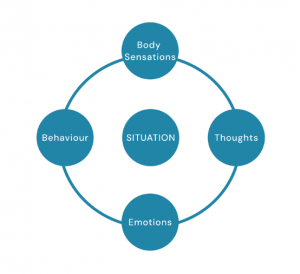
  • Noticing and paying attention and thoughts, feelings, behaviour, and everything else.
  • Mindfulness also describes a specific way of “being” that can be cultivated through practice.

Meditation

Meditation is a practice

  • It is only one aspect of mindfulness
  • Is when you take time to focus on the present, like your breath or an object, for a set period
  • Is a practice that can help one develop qualities like mindfulness

Breath Practice - Finding Your Anchor

Finding Your Anchor

Listen

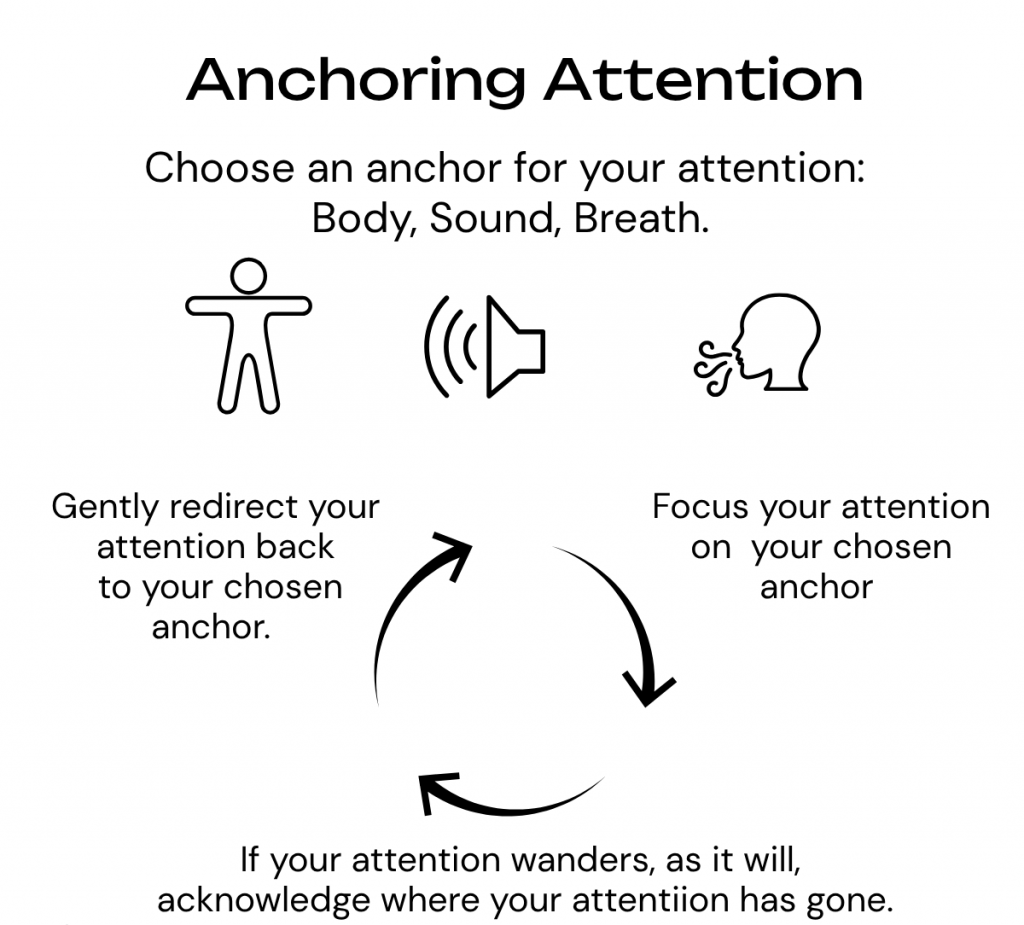
Choosing an anchor for attention during practice helps refocus the mind when attention wanders, which it will. Remember this as your “go to” place, if at any point, a practice becomes overwhelming.
Find the one that works for you – body, breath, or sound.

Benefits

  • Reduces Stress: It helps you face everyday worries and calm an overwhelmed nervous system.
  • Prevents Panic: A solid anchor helps you avoid panic and mental dissociation during hard times.
  • Improves Focus: Returning your attention to your anchor builds the part of the brain that controls focus.
  • Aids Clear Choices: Grounding yourself in the present makes it easier to choose intentional, calm responses.

Reflection Questions

  • Which anchor was easiest to bring your attention to the present moment?
  • Which one calmed your nervous system?
  • Which one felt best for you – body, breath or sound?

The Calm For Your Storm

“Be like a tree, with deep roots that reach way down into the ground. 
When a storm comes, the tree rocks a little and maybe gets a little wet. there’s no knocking down that tree.”

Reflection Question:

  • How might this quote be relvant to your own life?

Understanding How Mindfulness Can Impact Our Experience

It’s our perception that can impact our response. 

Mindful awareness can help manage the effects of negative stress by viewing stress as a challenge rather than a threat. 

Unhealthy Stress

Reacting to stress as a threat that you feel you don’t have the resources to overcome (e.g. time)

Healthy Stress

Responding to stress as a challenge that will be difficult, but you think you can successfully tackle 

Responding vs Reacting

Have you ever…

  • Said something you wish you could take back?

  • Done something that you later regretted?

  • How long did you think about the thing that you regretted doing before doing it?

  • How much time have you spent ruminating (obsessive over-thinking) about it

How long…

  • When asked how long it took to make the decision that landed them in jail, they said “Seconds”.
  • When asked how long their prison sentence was in consequence for that split second decision, they answered anywhere between months and years.

Take Away

  • 1 second reaction = long term consequences
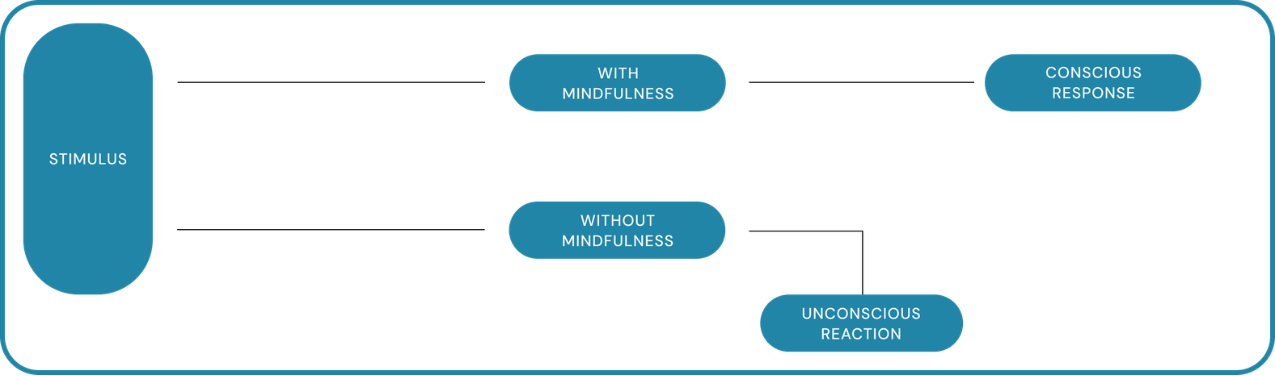
  • Between the stimulus and the response is a space and in that space is your freedom and power 
to make a choice.

Reacting

Acting before thinking

VS

Responding

Thinking before acting

Making The U-Turn

A 90-second pause is the difference between a reaction and a response. 

Focus Practice - STOPP

STOPP

Listen

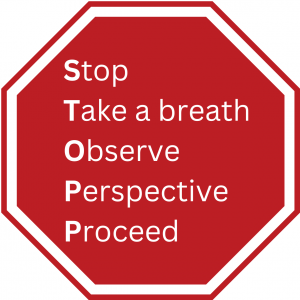
The ‘STOPP’ Practice offers a quick activity for grounding in times of overwhelm, anxiety, worry, and discomfort. 

Benefits

  • It can help you respond wisely to the situation, rather than reacting impulsively, and can have a positive impact on your well-being by ensuring a positive outcome. 
  • It helps create a space between the stimulus and the response and in the space, you can make a wise choice.

Reflection Questions

  • What is one specific type of situation or comment that makes you react without thinking?
  • How might the outcome of the situation  change based on the practice?

Healthy Habits - Reflect & Focus

Reflect – Time In

When we quietly reflect internally, focusing on sensations, images, feelings and thoughts, we become more aware of the impact of situations on us and we make better choices.

Focus Time

When we focus closely on tasks in a goal-oriented way, we take on challenges that form deep connections in the brain. When a person is focused on something, they’re paying attention to it.

Mindful Attitudes - Non-judgment & Beginner's Mind

Mindful Attitude - Non-judgment
Mindful Attitude - Beginner's Mind

Mindful Movement - Circle of Joy

Circle of Joy

Watch

Benefits:

  • Calms the body and mind: by using the breath efficiently.
  • Releases tension: in the upper body, particularly the shoulders and chest.
  • Increases the range of motion: in the shoulders.
  • Promotes a sense of joy and openness
  • Physically? Mentally? Emotionally?

Reflection Questions:

  • Did you find yourself focused? Unfocused?
  • Pleasant? Interesting? Or Unpleasant? Frustrating?
  • What did you notice?

Present Moment Awareness

Consider…

Past and Future

  • How many of you spend time thinking of things that happened in the past?
  • What about imaging things that might happen in the future?
  • What happens to the moment that you are in?
  • Are the thoughts that we often have pleasant or unpleasant?

Has anyone ever taught you how to pay attention?

  • Do you think that this might be a helpful skill?

Distractions

  • Have you ever been given a homework assignment that should only take you ½ hour and 2 hours later, you are still trying to find a way into it? 
  • What are your biggest distractions?

How Do You Focus?

  • Have you noticed that you do much better when you are focused?
  • When are you focused? Art, sports, drama….?
  • What helps you focus when a task is difficult or uninteresting about imaging things that might happen in the future?

Building the Muscle of Attention

Attention is like a muscle that can be trained. Just like you go to a gym to build muscles, practicing mindfulness – paying attention, noticing when the attention wanders, and bringing it back, builds the mucle of attention.

My Mindful Journey Reflection Journal

Complete the activities:

  1. What does well-being and mindfulness mean to me?
  1. How Mindfulness Are You? Quiz

  2. STOPP Practice Activity – Reacting VS Responding 

Download Printable PDF

The Wrap Up

Key Points About Mindfulness

  • Mindfulness is paying attention to here and now with kindness and curiosity so that you can make a wise choice.
  • Mindfulness supports positive health and well-being by reducing stress and anxiety, improviing focus and concentration, regulating emotions and increasing self-awareness.
  • Attention is like a muscle – it can be trained to develop focus and concentration. 

Final Reflection and Check -in

Mind and Body Word Check-in

  • Can you give one word (or more) for how your body feels right now?
  • Can you give one word (or more for how your mind is feeling right now?

Reflection Questions:

  • Was there a shift in how you feel after doing this lesson, learning about mindfulness and doing the activities and practices?
  • Where could you bring mindfulness into your life?

Resources

ResourceActivities_4

Mindfulness Lesson Activities

ResourceArt_5

Art Activity

ResourceLearn_3

Learn More

Web-based Resources

Videos to Watch

Mindfulness Lesson Activities

Additional stand-alone activities that support the lesson them. 

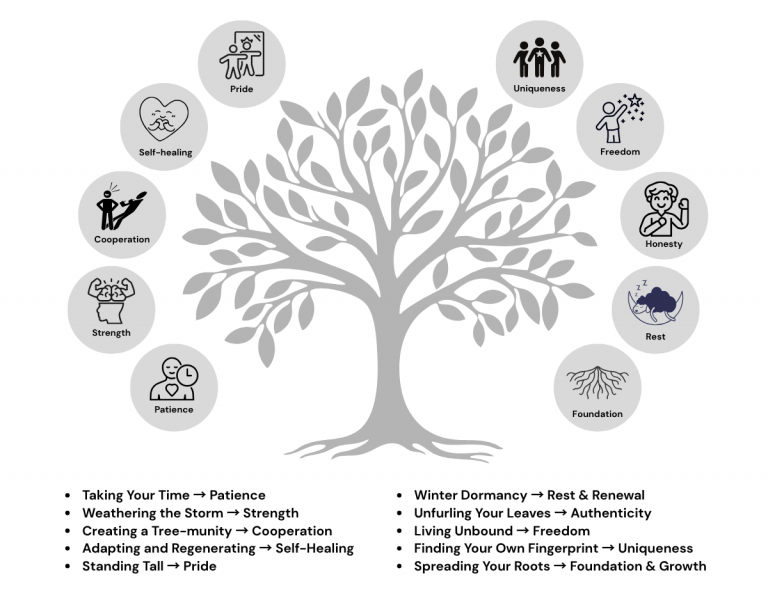
Be A Tree Activity

What Can We Learn From Trees?

Reflective Questions – Be a Tree:

  • Did you feel that your attention was focused during this practice?
  • Do you feel more or less energized?
  • Non-judgment: Did you find yourself judging yourself if you fell out of balance?
  • Beginner’s Mind: Were you able to approach the practice with a sense of curiousity?
  • Do you prefer physical mindfulness practices? Or reflective, stiller, quieter ones?

Fun Fact

What trees can teach us:

We need adversity to grow resilient. Challenges in life, unpleasant as they may be, make us stronger.

Back in 1991 in the middle of the Arizona desert the Biosphere 2 project was being conducted. The trees inside Biosphere 2 grew rapidly, more rapidly than they did outside of the dome, but they also fell over before reaching maturation.

Why did all the trees fall over before reaching maturity?

The conditions in the Biosphere were almost perfect. The temperature, humidity, water was all scientifically maintained, to be what was ideal for optimal grow. But, there was one thing missing…

It was the lack of wind or another way to put it, it was the lack of stress placed on the trees due to no wind in the Biosphere that caused the trees to fall over before reaching maturity.

Without wind, the trees did not develop a solid foundation and root system. They could not support themselves fully. They could withstand normal wear and tear, and survive. In other words, the trees needed some stress in order to thrive in the long run.

How true is this when it comes to human beings. We too need some stress in order to thrive in the long run.


 

Art Activity - Colour Walk

Instructions

  • Take a nature walk and pick a colour to focus on.
  • Collect photos of as many things in that colour that you can find.
  • Create a digital collage using your photos on a computer or phone. 
  • If you wish, print your photos and make a physical collage!

Reflection Questions – Colour Walk:

  • What colour did you pick and why? 
  • How does this colour make you feel?
  • Did you notice a theme within the photos you took? 
  • Does the colour you chose have anything to do with this?
  • What might your days feel like if you included taking a nature walk everyday?

Benefits

  • Stops Overthinking
  • Improves Mindfulness
  • Boosts Mood
  • Sharpens Focus
  • Sparks Creativity
  • Promotes Relaxation

Learn More

Wandering Mind

Key Aspects of Mind Wandering

Definition & Characteristics

Mind wandering is the experience of your attention drifting away from a primary task toward internal thoughts and memories.

Brain Mechanism

Driven by the brain’s Default Mode Network (DMN), it can be a source of great creativity but can also cause distraction, stress, or rumination if left unchecked.

Drawbacks

Excessive mind wandering, often seen in conditions like ADHD, can cause cognitive lapses, reduced performance, and unhappiness (or “unhappy mind”).

Benefits

It serves as a creative tool, aiding in problem-solving and allowing the brain to generate ideas when not focused on demanding tasks.

The mind wandering during practice is normal; that is what the mind is designed to do. The magic moment is noticing when the attention has wandered from the chosen anchor of attention, and then, gently and kindly bringing it back. It may happen many, many times, during mindfulness practice. Gradually, with practice and over time, awareness of the wandering mind and the refocusing of attention will improve the ability to concentrate.

Videos to Watch